

I crack my knuckles every day. Since I was a kid, people would tell me I was doomed for arthritis. There were a few feeble attempts to quit before I gave up and figured arthritis would be a problem for Future Jake.
I brought it up at a recent doctor’s appointment. The doctor chuckled and told me it’s a common misconception. It turns out that’s an old wives’ tale and that several studies that have failed to find a connection between knuckle cracking and arthritis.
So why did I believe my knuckle cracking habit would lead to arthritis?
The answer is strikingly simple: I heard the same thing over and over but never researched it. By merely hearing the information several times (“Cracking your knuckles will give you arthritis!”), I naturally assumed it was true.
My knuckle misconception was no big deal1. But it got me thinking about what else I might falsely believe. Where might I be relying on information that isn’t true? That I only believed because I heard it somewhere? And how exactly was this happening?
How We Learn
One of my favorite books is Thinking in Bets by Annie Duke. A former professional poker player, she goes into depth describing how our lives are a combination of the quality of our decisions and luck.
The root of our decision quality is the information we base those decisions on. Because of that, the book spends considerable time discussing how we learn information and update our beliefs.
Duke eloquently explains the difference between how we think we learn information and how we actually learn it:
“We form beliefs in a haphazard way, believing all sorts of things based just on what we hear out in the world but haven’t researched for ourselves.
This is how we think we form abstract beliefs:
We hear something;
We think about it and vet it, determining whether it is true or false; only after that
We form the belief.
It turns out, though, that we actually form abstract beliefs this way:
We hear something;
We believe it to be true;
Only sometimes, later, if we have the time or the inclination, we think about it vet it, determining whether it is, in fact, true or false.”
1. We hear something;
2. We believe it to be true;
3. Only sometimes, later, if we have the time or the inclination, we think out it and vet it, determining whether it is, in fact, true or false.”
Unsurprisingly, our brain works like this because of evolution. It was advantageous for our ancestors to accept new information as true to make faster decisions while expending less energy. If there was rustling in the bush, assuming it’s a predator was safer than waiting for confirmation.
We used to accept new information as fact by default because we only learned from our own experiences and from interactions with the trusted confidants in our tribe. As we developed language and communicated with a wider range of people, our brain kept the same pattern of experience-something, accept-as-true, question-later-maybe.
That process resulted in greater odds for survival and reproduction and were eventually passed down to modern humans.
To make matters worse, it’s hard to reverse.
It takes extra energy to think back to a past fact, reconsider why we know it, and then override the information if necessary. Because it takes extra energy, we only do it if we really must.
“Wanna bet?” is the example that Duke uses as a trigger to force your brain through Step 3 in the quote above. The prospect of losing money forces you to take a step back and evaluate what you know, why you think it’s true, and how confident you are. Without a nudge, we’re content to accept what we hear as fact without vetting it.
That’s the root of why I believed knuckle cracking would lead to arthritis. I heard it mentioned several times. Accepted it as true by default. I never had a reason to challenge or reconsider it and went years with a false belief before I updated my information.
Living With Our Modern Brain
Our brains are virtually the same as they were 100,000 years ago. The rest of the world has changed a little bit over that period. The shortcuts that helped us survive in a hunter-gatherer world can cause chaos today.
We accept things as true by default, we rarely re-evaluate something we’ve heard, and we’re hard pressed to update our beliefs. Not particularly helpful!
These days, we’re no longer getting information solely from our own experiences and members of a tight knit tribe. We’re flooded with headlines, social media posts, and now AI outputs that have their fair share of hallucinations.
Today’s world of constant information bombardment means the way we learn information can be deceptively dangerous.
To make matters worse, our brain also naturally prefers to listen to opinions that agree with our priors instead of ones that challenge us. Algorithmic feeds create echo chambers that exacerbate this.
Unfortunately, we can’t rewire how our brains work. Unless there’s a reason to challenge new information, it just seeps into our heads and is absorbed as fact.
The best thing we can do is be wary that’s how our brains work and be extra cautious when we rely on things “we think we heard” somewhere.
Most decisions in a day aren’t particularly important. But when major decisions come up, it’s worth slowing down and examining the assumptions behind them.
Take a pause. Crack your knuckles.
What information are you using to make the decision?
Do you think it’s true? Where did you hear it from? How confident are you?
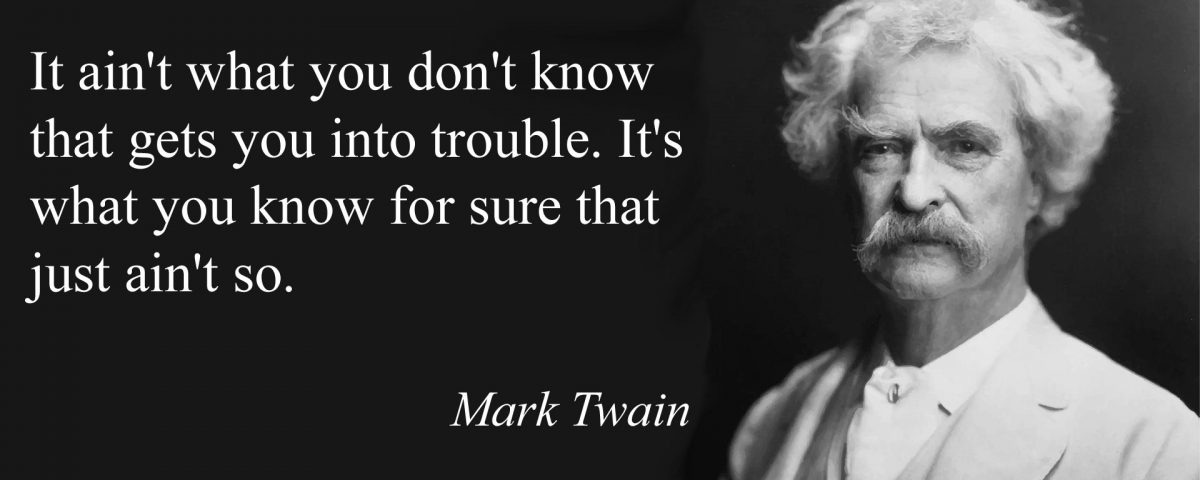
With the way our brains work, be careful about those things you know for sure that might not be so.
Would you “Wanna bet?” based on it?
Ironically, I might get arthritis in the future thanks to genetic factors. Not knuckle-cracking related!