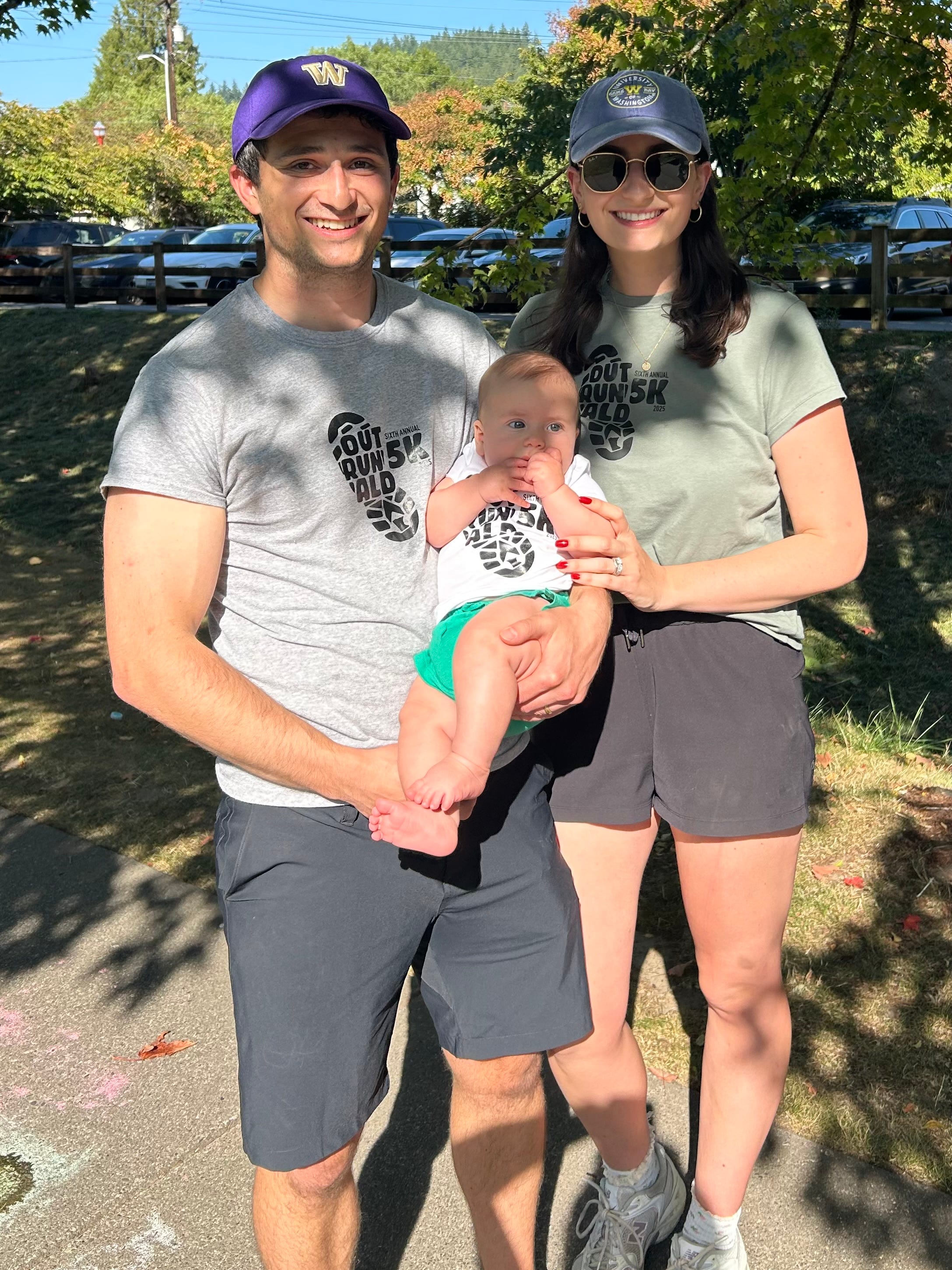
As new parents, we knew our child was special. We just didn’t realize he was “1 in 15,000” special.
Within minutes of being born in May 2025, Bennett’s heel was pricked to draw a few drops of blood. His blood sample was tested for 35 different diseases as part of standard newborn health screenings.
The diseases they test for are typically undetectable in otherwise fully healthy babies. Ones in which it’s too late for intervention when symptoms start to appear.
10 days later we got a call from our pediatrician. He let us know that Bennett had been flagged for something on the newborn screen. “Probably nothing. Odds are it’s a false positive”.
A 2nd test confirmed that Bennett has X-Linked Adrenoleukodystrophy.
Only in our first month of parenthood and we were suddenly confronted with scary world of rare diseases. X-Linked Adrenoleukodystrophy (xALD) is only detected in about 200 babies per year in the United States.
Panic ensued. Tears.
I coped by reading everything I possibly could online – sticking to the scientific articles because the personal stories from other parents are heartbreaking.
xALD is a condition in which the body has a difficult time breaking down a few specific very-long-chain fatty acids. The result is a buildup of these chemicals in the body. This can happen in the brain, the spinal cord, or the adrenal glands.
The seriousness of the condition depends on where in the body the buildup occurs.
If it’s in the adrenal glands, the body has a difficult time recovering from sicknesses and stress. It can be treated with regular hormone replacement pills.
If it’s in the spinal cord, it can lead to mobility issues (leg stiffness and weakness) and bladder control issues.
If it’s in the brain, it progresses through seizures, a vegetative state and eventually death. Once symptoms appear, it is irreversible.
The adrenal and spinal cord variations can appear at any age. The brain version is most common in kids 3-12 years old.
It’s terrifying stuff.
While still figuring out normal new parent things, like you know, how to handle a crying baby at night, we were also working with a team of doctors to figure out our care plan and managing our own fears.
The good news is that there are treatments for each of these potential presentations of the disease. Even the brain form, the most severe one, can be treated with a bone marrow transplant before symptoms appear. We’ll have options.
The challenging part is that there’s nothing we can do proactively to prevent the buildup of acids. We’ll do a lot of regular testing to catch early changes in his body before symptoms start to appear.
Every 3 months, he get a blood draw. Starting next year, he’ll do an MRI every 6 months.
If you haven’t had the opportunity to watch a baby get a blood draw - it’s not fun! Especially when it takes several minutes of screaming because their tiny veins are hard to find. We’ll need anesthesia to sedate him for MRI’s until he’s old enough to lay still.
Our lives are a recurring cycle of dreading an upcoming test, relief at the results, and then a few month reprieve before we repeat the cycle.
There is no way to predict where the fatty acids will build up in Bennett, and therefore which variation he may have. It’s possible that he never has any issues, and we pray for that every day.
The most difficult part is the unknowingness.
There’s no finish line. No date that we’ll know anything definitively. No final test. We’ll have xALD lurking around our family for the rest of our lives like an unwanted shadow.
In the early months, doctors urged us to not let the diagnosis consume us and prevent us from enjoying the fleeting baby moments. If you focus on the fear of what may come, it’ll eat you alive and ruin the moments you have now.
And right now, we have an amazing toddler in front of us, who loves his dog and waves at everyone he meets.
As painful as it is, we’re grateful that we know about Bennett’s diagnosis. Screening for xALD is relatively new. New York became the first state to have to screen newborns for it in 2013 and Washington State followed suit in 2018.
If Bennett was born just 8 years ago, it’s possible we would have believed we had a fully healthy baby boy all the way until it was too late to do anything. I keep telling myself it’s far better to know he has this and live with the anxiety of recurring medical tests than to potentially live in bliss and not know until it’s too late.
I’ve found some peace with the Serenity Prayer:
“God, grant me the serenity
to accept the things I cannot change
the courage to change the things I can
and the wisdom to know the difference.”
Our xALD journey has been the best test I’ve ever faced at focusing on what you can control.
I cannot change our diagnosis. I cannot change how it may develop in the future.
One of the few ways I can impact change is to support the research and work of the teams that are making progress in the field of xALD.
Our local doctors have all been great, but they just don’t know that much about xALD since it’s so rare.
Dr. Troy Lund and his team at the University of Minnesota are the experts. Having a group that focuses on xALD day in and day out has made such a difference. Their team works with patients and does research in the field. They’ve been incredibly gracious and helpful to us while we’ve navigated this journey.
We can’t control the results of our next blood draw or MRI. For now, all we can do is support the doctors and researchers working hard every day to make the world a better place for families like ours.
On September 19th, we’ll be participating in a virtual 5k with a group walk in our neighborhood. We’re raising money for X Out ALD to fund the University of Minnesota’s Leukodystrophy Center for ALD research. You can donate to our team here.
Parenting has been easy. It’s been much harder to learn to live in the moment without fearing what the future may bring. Right now, we’re focused on supporting the researchers in the ALD field and staying present while we chase our silly, energetic toddler around the house. Our hope is that the continued work on awareness of xALD and research into in the field will help families like ours and little boys like Bennett in the future.