


We don’t communicate with numbers enough. Numbers are clear, concise, and leave zero room for misunderstanding. Instead, we default to squishy words with ambiguous meanings.
Several years ago, I traveled to Las Vegas for the International Builders’ Show. I attended a dozen classes about finance and homebuilding, but the most impactful presentation focused on team communication.
The speaker asked the room to think about the word “often”. What did the word mean to us? How did we feel about it? After a moment, he continued:
“If I told you that something happens ‘often’, how many times out of 100 do you think it occurs?”
The crowd of 200+ submitted their answers through a website poll. The opinions were quickly tallied and graphed. The results showed a bell curve that ranged from 35 to 80!
“How” the speaker asked, “is it reasonable for us to communicate if one person thinks ‘often’ means 35% of the time and someone else thinks it means 80%?”.
We might both speak English, but if our definitions of a word are that different, then we aren’t speaking the same language.
This chart is a cool visual of the same idea. Look at how wide some of the ranges are! These are words in our everyday vocabulary that have a huge variance in how different people perceive them.
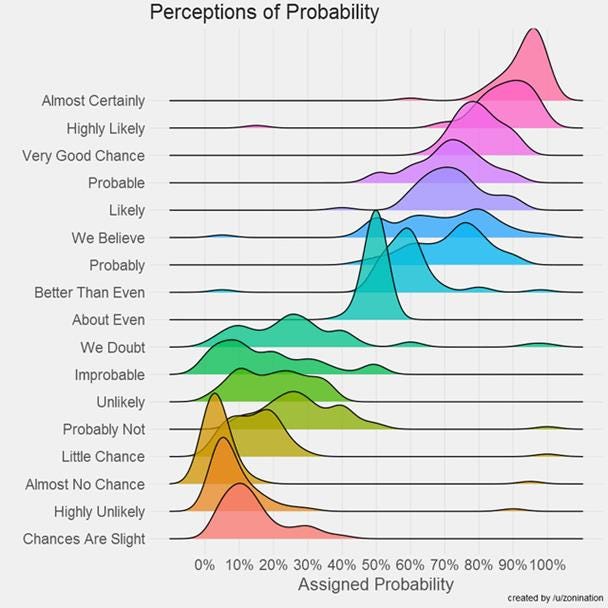
These probabilistic phrases mean different things to different people. There is no shared definition that lets us be certain that we’re on the same page.
I’ve seen this picture floating around online before. It’s a great example of how much stronger our communication is if we avoid subjectivity.
The more objective we can be, the more likely we are to be understood. And the best way to be more objective is to use numbers.
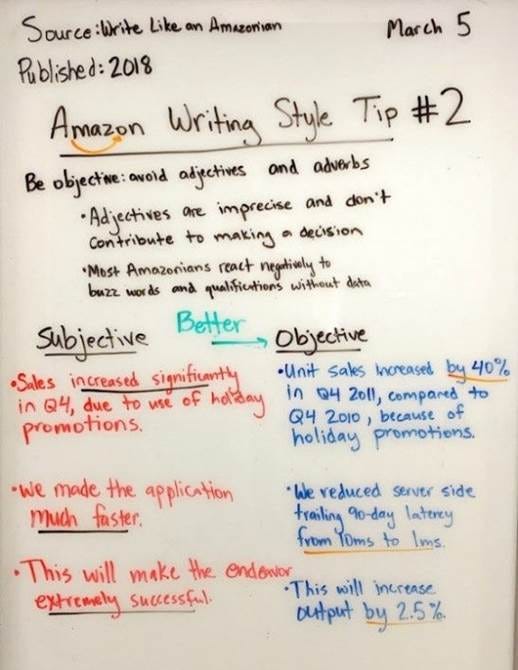
The first example in the image illustrates this perfectly. “Increased significantly” could mean anything depending on the context and on our own perceptions of what ‘significantly’ means.
I’m going to guess that the writer and reader wouldn’t have agreed that “increased significantly” = 40%.
Using the number leaves zero room for error. It doesn’t matter what language you speak or your cultural background. Anywhere around the world, 40% means 40%.
Sure, there’s times when you don’t have exact numbers handy. Even an estimated numerical range is better than nothing.
I’ve been trying to focus on communicating with numbers more. When someone tells me that a project “shouldn’t take that long”, I’ve been pressing for a ballpark. Does that phrase mean 3 days? 8 weeks?
The answer is entirely dependent on context (and opinion). 8 weeks would be record speed to build a house but an eternity to update text on a website.
As much as I can, I’m trying to eliminate the following from my vocabulary:
Sometimes, frequently, occasionally, all the time, often, rarely, regularly, constantly.
Everyone has their own understanding of what those words mean. Instead, I’m trying to replace those types of phrases with numbers. Telling someone that “around 20-40% of users experience this issue” is a hell of a lot better than “some users experience this issue”.
Communication is hard, and subjectivity makes it even harder. We all have the same definition of 50%, 75%, or 95%. Replacing our descriptive words numbers will improve our communication.
Try it out yourself. It should help pretty often.